Research & Frontiers
Explore the challenges scientists are working to solve—and learn how to read the evidence.
Research spotlights
Start with a question. Follow the mechanism. Understand the limits.
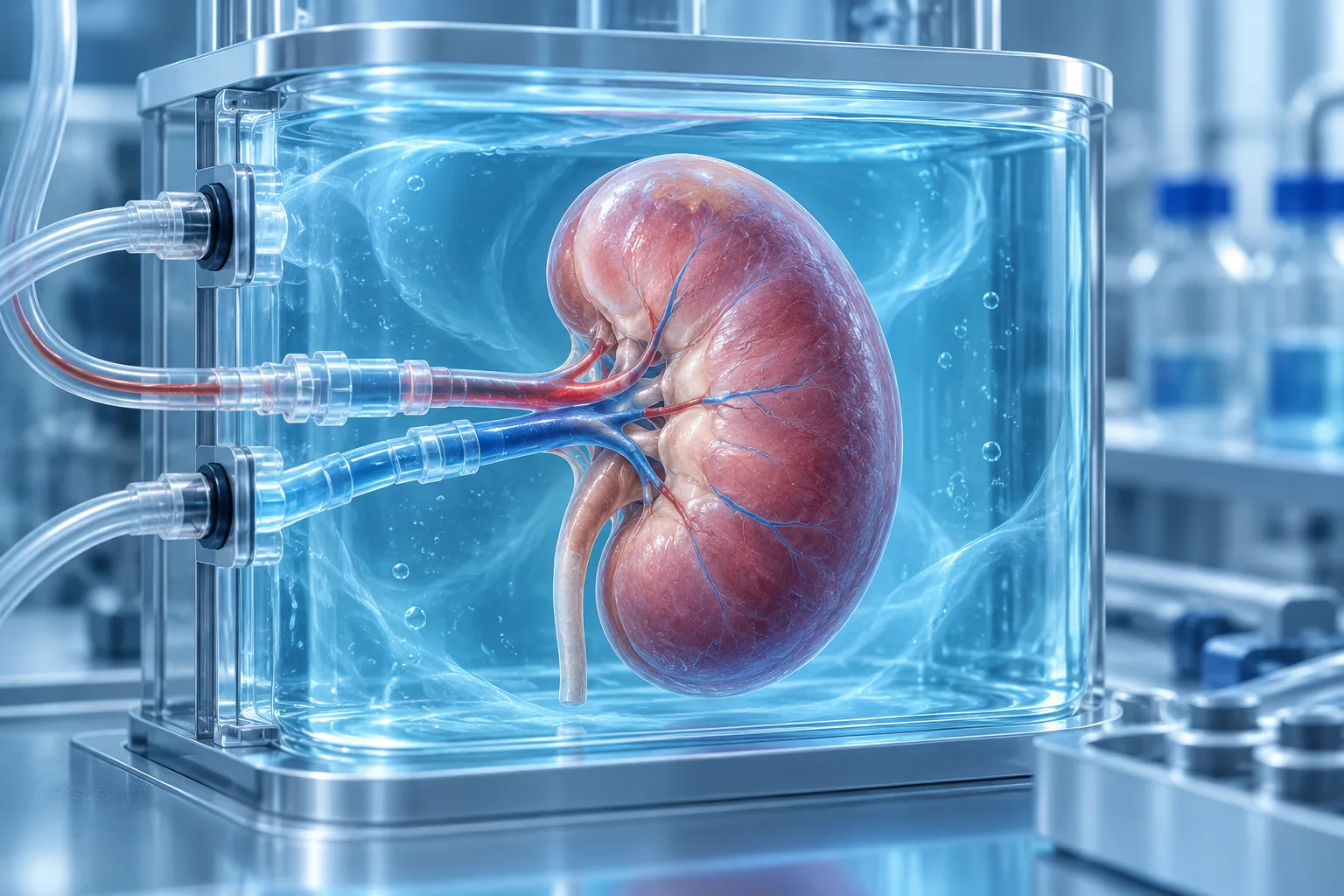
Could we build an organ bank?
What a rat-kidney study tells us about the promise—and the limits—of longer storage.
BioengineeringWarming from the inside out
Explore how distributed heat generation could help larger samples return from the cold.
ImmunologyPreserving the immune system’s messengers
Why dendritic-cell preservation needs endpoints beyond immediate survival.
Cryoprotective chemistryCan we use less DMSO?
A lower concentration is a research question, not a guarantee of a better formulation.
Organ preservationBelow freezing, still liquid
How supercooling differs from freezing and vitrification.
BiomaterialsLearning to influence ice
Ice-binding proteins and synthetic materials raise a useful question: can we control crystal behavior?
Comparative biologyWhat can hibernators teach us?
Natural metabolic suppression offers questions for preservation research.
What is ATP-Bio?
ATP-Bio is the National Science Foundation Engineering Research Center for Advanced Technologies for the Preservation of Biological Systems. Co-led by the University of Minnesota and Massachusetts General Hospital, it brings researchers together to improve how living materials—from cells and tissues to whole organs—are preserved, stored, and transported.
Its work addresses questions at the heart of cryobiology: how to control ice, reduce damage from cryoprotectants, and restore function after warming. Applications extend beyond transplantation to biodiversity and food systems.
Learn about ATP-BioCurrent challenges
Approaches under exploration
Vitrification
A glass-like solid state that avoids crystalline ice.
Nanowarming
Distributed heating to address rewarming challenges.
Synthetic ice blockers
Materials being investigated to influence ice formation or growth.
Ice-binding proteins
Biological molecules that interact with ice surfaces.
Trehalose-based strategies
Sugar-based protection, with delivery and cell-specific limitations.
Lower-DMSO approaches
Testing alternatives with biological function as an endpoint.
Supercooling
Keeping a solution liquid below its equilibrium freezing point.
Machine perfusion
Controlled fluid circulation through an organ outside the body.
Organ banking
A long-term goal requiring recovery of integrated organ function.
Research is a process, not a promise.
Spotlights distinguish measured findings from research ideas. Dedicated citations are marked as pending where they have not yet been supplied.
Our scientific standards